
Chaunsa: why Pakistan's king mango refuses to travel by plane until it's ready
From Multan's white-hot summer to your kitchen, the 11-day journey of the most coveted Pakistani mango.
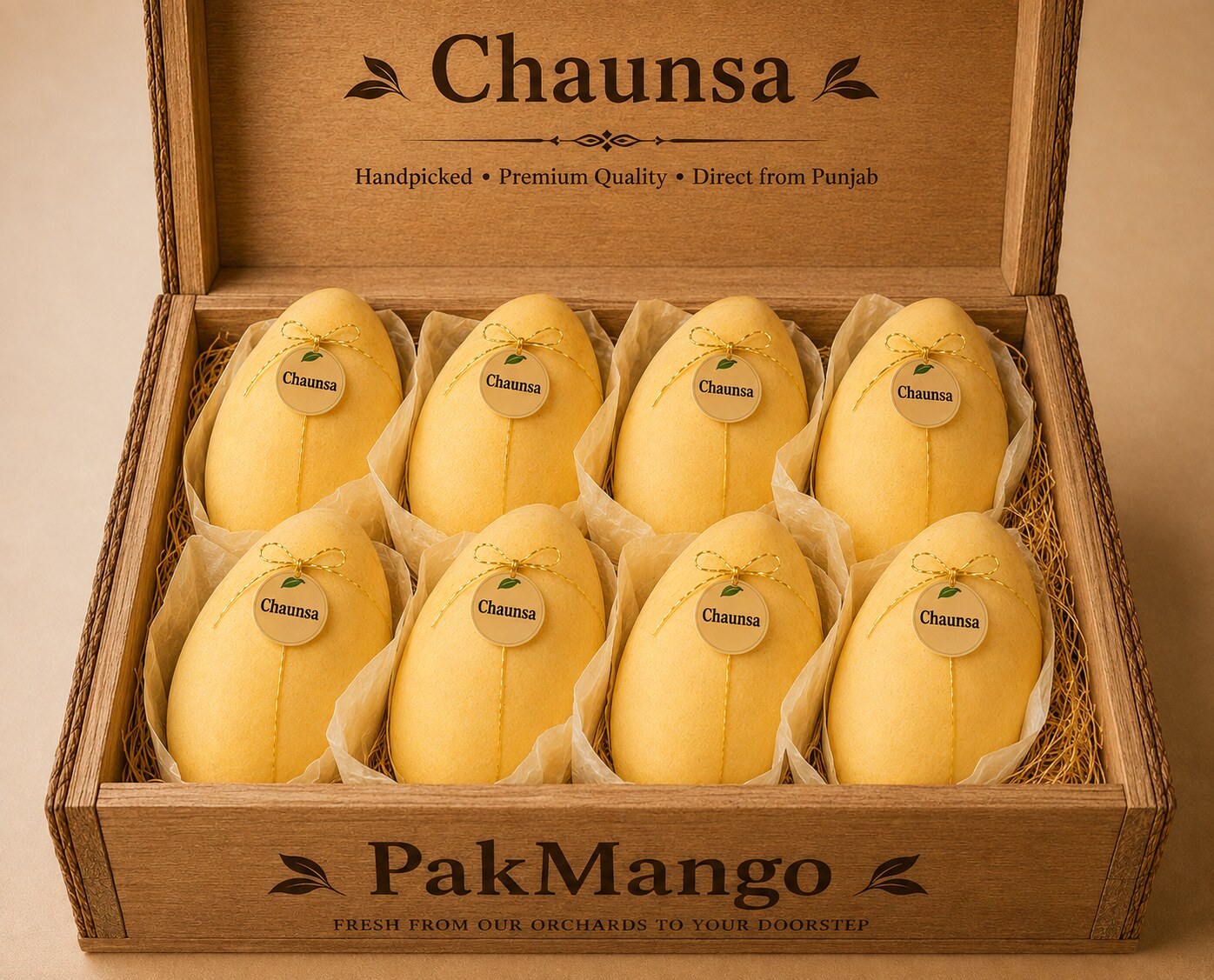
The mango Mughal emperors fought over
Chaunsa's name comes from Chausa, a town in Bihar where the Mughal emperor Sher Shah Suri is said to have celebrated victory in 1539 by handing out the mango. Centuries later, the variety became closely associated with southern Punjab, where the region's hot summers and river-silt soils suit it particularly well.
Chaunsa trees are slow to mature and reward patience. Older, well-established grafts in the wider Multan region are typically valued for the more perfumed, honeyed fruit they produce.
Picked at the right moment for the journey
Chaunsa needs to be picked at the right point in its ripening curve. Picked too early, the fruit stays starchy and never develops its honey note; picked too late, it won't travel well. Cartons are prepared at partner orchards in Sindh or Punjab, then airfreighted to the UK.
Once in the UK, cartons are handed to tracked delivery. Delivery dates are estimates, not guarantees, harvest, weather, flights and customs may affect timing.
How to eat one properly
A perfectly ripe Chaunsa yields to the slightest press, like a ripe avocado. The skin will be uniformly golden, with no green at the shoulder. Cut it in half lengthwise around the stone, then score the flesh in a grid and turn it inside out, the cubes pop up clean.
Or do what most of Pakistan does: roll it gently between your palms for two minutes, bite a small hole at the top, and squeeze the juice straight into your mouth. There is no wrong way.
How Chaunsa fits into the Pakistani mango season
The Pakistani mango season typically runs from May to August. Sindhri usually opens the year, Chaunsa carries the mid-summer window, Anwar Ratol and Dosehri overlap in mid-season, and Langra tends to close things out in August. Chaunsa generally sits in the historical harvest window: june to august window, timing varies each year with the harvest.
If you're new to Pakistani mango, the simplest plan is to try one variety at a time across the season. Availability varies through the season, see current availability on the shop before you order.
About Chaunsa
Chaunsa is one of several Pakistani mango varieties that PakMango.Com offers in season. It is generally associated with orchards in Multan, Punjab. Precise sourcing information for the current year's fruit is confirmed on the product page and in your order confirmation.
Fresh Pakistani mango is a seasonal product. What is actually available this week is shown as current availability on the shop.
How ordering and delivery work
Fresh Pakistani mango consignments arrive through the season. Most volume goes into our UK wholesale network; direct customer orders are allocated from the freshest available arrival. PakMango dispatches Monday to Thursday across mainland UK, and the carrier's expected delivery follows dispatch. Carrier delays are possible, so delivery dates are estimates, not guarantees.
Delivery is by tracked delivery across the UK. Tracking is emailed once the carton enters the courier network. Delivery dates are estimates, not guarantees, harvest, weather, flights and customs may affect timing.
For anything specific to a carton, a courier delay, a damaged box, or a question about arrival, contact support via the contact page and we will help you resolve it in line with our published shipping and refund policy.
Comparing Pakistani mango to other options
Pakistani mango varieties have their own flavour signatures, Sindhri's citrus brightness, Chaunsa's honeyed sweetness, Anwar Ratol's perfume, Dosehri's delicate honey-melon, Langra's tropical complexity. They are different from Alphonso, Ataulfo/Honey and Kent-family supermarket mangoes in taste, texture and season.
As with any imported tropical fruit, ripeness at arrival depends on how the fruit is handled through the supply chain. If perfume and full flavour matter, plan to ripen at room temperature until the fruit yields to a gentle press, then refrigerate briefly before eating.
Where to read next
For a general seasonal overview, see the Pakistani mango season guide. For variety-specific details, see the varieties pages linked at the foot of this article.
For practical questions about ordering, timing and delivery, see the delivery page and the FAQ. For anything not covered there, the contact page is the fastest route to support.
Frequently asked questions
- When is Chaunsa in season in the UK?
- Chaunsa typically arrives in the UK from mid-June through late August, with the honey-Chaunsa window generally in July. Availability varies each year with the harvest, check current availability for what's actually available this week.
- How is Chaunsa different from Indian Alphonso?
- Alphonso is brighter and more acidic; Chaunsa is rounder, sweeter and more honeyed with a longer finish. Most British-Pakistani families consider Chaunsa the dessert mango par excellence.
- How do I ripen a Chaunsa carton at home?
- Leave the carton open at room temperature for 24 to 72 hours. Once a fruit yields to gentle pressure and smells fragrant at the stem, move it to the fridge to slow ripening. Eat within 3 days of moving to the fridge.
- Can I freeze Chaunsa pulp?
- Yes. Peel, deseed, blend the pulp with a teaspoon of lemon juice per kg, then freeze in 250g portions. Frozen pulp keeps for 9 months and is perfect for lassi, kulfi or chutneys out of season.
- Why does my Chaunsa have green patches?
- Honey Chaunsa often keeps a slight green blush at the shoulder even when ripe, the give of the flesh is a better ripeness signal than colour. If the fruit smells sweet at the stem, it's ready.
- Where can I buy fresh Chaunsa in the UK?
- PakMango.Com offers Chaunsa cartons in season. Orders can be placed online at any time and dispatch runs Monday to Thursday. See current availability on the shop, then check the delivery details before ordering.
More from the journal
Sindhri: the mango that announces summer two weeks before everyone else
Pakistan's earliest premium variety, grown in the heat-shock plains of lower Sindh.
Anwar Ratol: the cult mango Pakistanis ration like saffron
Small, fragrant, and gone in three weeks, the variety that proves bigger is not better.
Dosehri: the honey pearl that perfumes a kitchen
Translucent flesh, oval like a teardrop, and a fragrance so delicate it feels like eating a flower.
Share this article